After years on the sidelines of Nigeria’s fiercely competitive mobile money space, Airtel Nigeria is relaunching its digital wallet, SmartCash, betting on aggressive incentives and wider physical distribution to gain relevance.
Nigeria’s mobile money landscape has evolved rapidly since the Central Bank of Nigeria introduced Payment Service Banks (PSBs) in 2018, allowing telecom operators to offer limited financial services under strict regulations. However, telecom-led fintechs have largely struggled to convert massive subscriber bases into financial dominance.
Despite boasting 60.89 million subscribers and ranking as Nigeria’s second-largest telecom operator, Airtel’s SmartCash remains a fringe player. As of December 2025, the platform had 2.2 million users and generated just $6 million in revenue, a sharp contrast to fintech heavyweights like OPay and PalmPay, which dominate daily payments, transfers, and deposits. PalmPay alone reported $63.9 million in revenue in 2023, reflecting explosive growth over three years.
A Booming Market, Tough Constraints
Mobile money is Nigeria’s fastest-growing financial services segment. Transactions hit ₦20.71 trillion ($13.49 billion) in the first quarter of 2025, according to Nigeria Inter-Bank Settlement System—a staggering 1,518 per cent increase from Q1 2021.
Yet regulation remains a key constraint. PSBs are barred from lending, face higher capital requirements, and entered the market later than fintech startups. Industry players argue that these limitations have curtailed growth and competitiveness for telecom-backed wallets.
Incentives at the Core of Airtel’s Strategy
On Airtel Africa’s fiscal Q1 2026 earnings call, group CEO Sunil Taldar acknowledged the intensity of competition but said the company would leverage its brand, agent network, and customer base to carve out a sustainable niche.
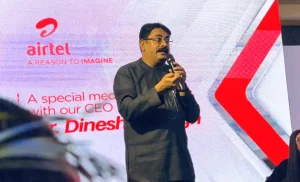
Expanding on this strategy at a media briefing on February 5, 2026, Airtel Nigeria CEO Dinesh Balsingh outlined SmartCash’s reboot, anchored on free transfers, cashbacks, and savings.
“All transfers on SmartCash are currently free, and users receive cashbacks on airtime recharge, bill payments, and wallet transactions,” Balsingh said, adding that the goal is to reward customer loyalty and drive usage.
To attract deposits, SmartCash is offering a flat 15 per cent annual interest rate on savings—without tiers, caps, or thresholds. “Whatever you put into your saver’s wallet gives you 15 per cent interest, no questions asked,” Balsingh explained.
Building Infrastructure, One Terminal at a Time
Beyond incentives, Airtel is scaling its infrastructure. SmartCash is now integrated with multiple banks, enabling wallet-to-bank and interbank transfers. Physical distribution remains central to its expansion, with nearly 60,000 PoS terminals deployed across agent locations, supermarkets, and merchants.
While this lags behind fintech rivals—Moniepoint alone operates over one million terminals—it reflects Airtel’s effort to expand beyond its retail ecosystem. Nigeria’s active PoS terminals have surged from under 600,000 in 2021 to nearly six million in 2025, driven largely by fintech growth.
Airtel has also signalled plans to introduce a virtual card and additional use cases in 2025, as it seeks deeper customer engagement.
Telcos Still Chasing Fintech Success
Telecom-led fintechs continue to trail standalone players in Nigeria. Even MTN’s fintech arm has relied heavily on airtime lending to drive revenue growth, underscoring the difficulty of replicating fintech-style scale under PSB rules.
The contrast is stark when compared with the success of M-Pesa in Kenya, or Airtel’s own mobile money dominance in parts of East Africa.
In its State of the Industry Report on Mobile Money 2024, GSMA argued that Nigerian telcos’ scale and capital base could eventually give them an edge—but only if incentives are matched with greater regulatory flexibility, similar to frameworks in Kenya, Tanzania, and Ghana.
For now, Airtel’s SmartCash reboot represents another high-stakes attempt to turn telecom reach into financial relevance in Africa’s largest economy.