
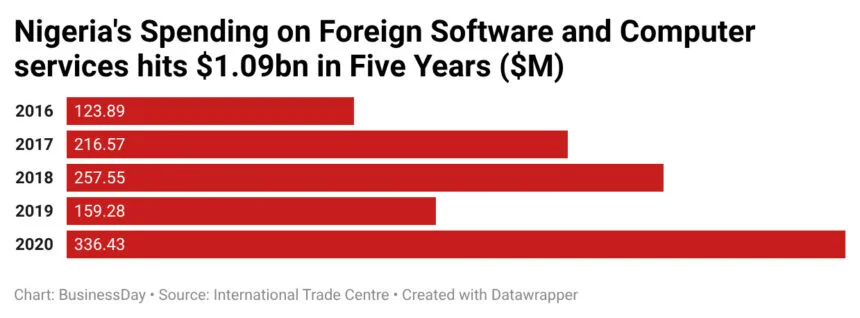
Nigeria’s heavy dependence on foreign technology has come under renewed scrutiny as global supply disruptions continue to strain the country’s digital economy, with over $1.09 billion spent on software and ICT service imports in recent years.
Data from the International Trade Centre shows that between 2016 and 2020, Nigeria’s spending on software acquisition and computer services surged significantly, peaking at $336.43 million in 2020. The trend highlights the country’s growing reliance on foreign digital solutions amid rising demand for technology.
The vulnerability has been further amplified by geopolitical tensions in the Middle East, particularly around the Strait of Hormuz, which have driven global oil prices above $100 per barrel. Despite being a major crude oil producer, Nigeria has faced rising domestic fuel costs, worsening inflationary pressures and exposing structural weaknesses in its economy.
Experts say the situation reflects a broader challenge beyond energy—Nigeria’s deep-rooted dependence on imports across critical sectors, especially technology. According to the Nigerian Communications Commission, about 84 per cent of telecom hardware used in the country is imported, while only 16 per cent is produced locally. Software reliance is similarly skewed, with 77 per cent sourced from foreign providers.
This imbalance has significant economic implications, including sustained pressure on foreign exchange reserves and increased exposure to global supply chain disruptions. It also raises national security concerns, given the reliance on foreign-built digital infrastructure.
However, there are signs of progress. A policy introduced at the Nigerian Telecommunications Indigenous Content Expo banning the importation of fully assembled SIM cards has helped stimulate local production. Within a year, the local SIM manufacturing market grew to over N55 billion, demonstrating the potential of targeted industrial policies.
Former telecom regulator chief Umar Garba Danbatta noted that strengthening indigenous capacity across the value chain remains critical for sustaining growth in the sector. Initiatives such as the Nigeria Office for Development of Indigenous Telecoms Sector are also focused on boosting local manufacturing, research, and skills development.
Despite these gains, Nigeria still loses an estimated $2.8 billion annually to ICT imports, according to Isa Pantami, underscoring the urgency for reforms that prioritise local innovation and production.
Industry players, including Zinox Technologies, have demonstrated the viability of local solutions through domestic computer assembly and integrated technology offerings. Stakeholders argue that scaling such efforts could reduce capital flight, create jobs, and strengthen economic resilience.
Analysts warn that without consistent policies, infrastructure investment, and stronger public-private collaboration, Nigeria risks remaining exposed to global shocks. As uncertainty persists in international markets, experts say building local capacity is no longer optional but essential for long-term stability.
For Africa’s largest economy, the message is clear: reducing dependence on imported technology and investing in homegrown innovation will be key to safeguarding its digital future.