
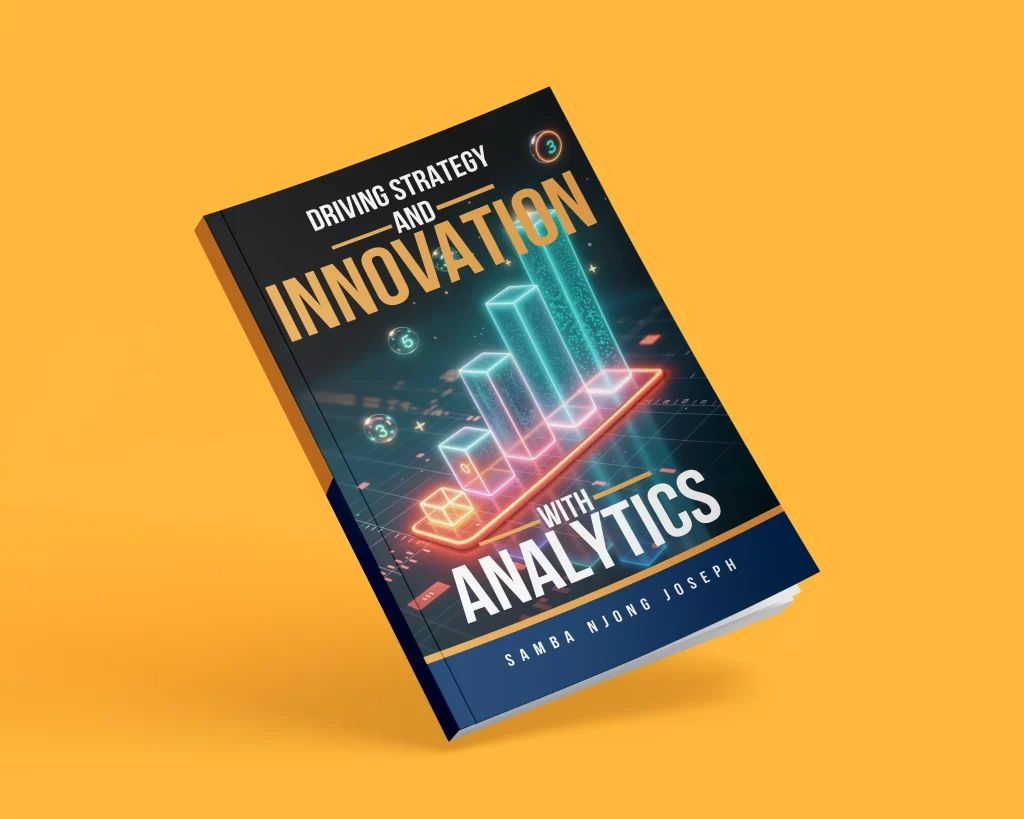
Nearly 70% of West-African SMEs identify poor planning and weak decision-making as critical barriers to scale. Yet amid a sea of general business advice, one publication, Driving Strategy and Innovation with Analytics by Samba Joseph, has quietly become a staple among entrepreneurs, operations leads, and even public administrators. It’s not just being read; it’s being used.
Instead of speaking solely to analysts or academic circles, its principles have found their way into startup accelerators, boardroom discussions, and policy planning sessions. The result is a clear shift in how Cameroonian businesses, especially SMEs, approach strategy: not as guesswork, but as structured action grounded in data.
The numbers speak louder than endorsement. Companies implementing the book’s frameworks report between 15–25% gains in operational efficiency, achieved through more accurate demand forecasting, better inventory cycles, and smarter allocation of staff and capital. In the logistics sector, data-backed route modeling has helped some firms reduce fuel costs while increasing daily order volume, thanks to improved delivery flows.
Larger players are applying the lessons too. At least three commercial banks and two telecom firms have leveraged insights from the book to rebuild customer analytics systems, leading to more accurate churn modeling, improved customer lifetime value, and measurable improvements in campaign targeting. One telco publicly linked a year-on-year revenue increase to revised internal models first explored through his frameworks.
Beyond performance gains, the book has had a quiet hand in de-risking early-stage ventures. Founders equipped with better tools to define their unit economics and forecast growth trajectories are presenting more credible cases to investors. Accelerator programs in Douala and Bamenda now integrate the book into early-stage training, citing a higher funding success rate among startups that use its methods.
Government agencies aren’t far behind. In departments long plagued by budget overruns and poor forecasting, select public units have begun using analytics structures from the book to improve tax planning, program tracking, and budget allocation, especially in sectors like health, education, and agriculture. These aren’t sweeping reforms yet, but they’re significant steps toward measurable fiscal discipline.
The book’s growing footprint lies in a simple but essential contribution: helping Cameroonian enterprises connect insight to income, and data to direction. It doesn’t promise reinvention; it enables refinement. And in an economy where uncertainty is constant, Driving Strategy and Innovation with Analytics has become a steadying influence, one that is pushing performance not with hype, but with method.